
Amazon Australia FBA Fees: The 2026 Breakdown Every AU Seller Needs
Most guides to Amazon PPC jump straight to bids and budgets. Before any of that matters, you need to know what each sale actually costs you to fulfil. On Amazon.com.au, that means understanding two fees, how GST interacts with them, and what they do to your break-even ACoS — the number that decides whether ads make you money or bleed you out.
The Two Fees That Hit Every Australian Sale
Every Amazon Australia FBA sale carries two mandatory fees (media items and Individual-plan sellers pick up a third — more on that below). They come out before you see a cent.
Referral fee — a percentage of the total sale price (including any shipping you charge). Amazon takes this for connecting you with the buyer. It goes to Amazon whether the sale is profitable or not.
FBA fulfilment fee — what Amazon charges to pick, pack, and ship the unit from their warehouse. This is separate from the storage fees you pay to keep inventory there. Fulfilment fees scale with size and weight.
Understanding both — not just one — is what separates sellers who know their margin from sellers who discover it's not there after they've been running ads for six weeks.
Amazon Australia Referral Fees by Category (2026)
This is where most US-imported margin models break. AU referral fees are not a straight copy of the US schedule — several categories use tiered rates that step down (or up) at a price threshold, which means your effective rate changes with your price point.
Here are the current rates from Amazon's AU pricing schedule (checked August 2026):
| Category | Referral Fee |
|---|---|
| Alcoholic Beverages | 10% |
| Automotive and Powersports | 10.5% |
| Baby Products | 8% up to $20, 11% above $20 |
| Base Equipment Power Tools | 7% |
| Beauty, Health, and Personal Care | 8% up to $20, 13% above $20 |
| Business, Industrial and Scientific Supplies | 11% |
| Clothing & Accessories | 10% up to $20, 13% above $20 |
| Computers | 8% on the first $150, 6% above |
| Consumer Electronics | 8% |
| Electronics Accessories | 13.5% |
| Furniture | 12% |
| Grocery and Gourmet | 8% up to $20, 10% above $20 |
| Home and Kitchen | 13% |
| Home and Kitchen Appliances | 8% |
| Jewellery | 15% on the first $200, 5% above |
| Lawn & Garden | 10.5% |
| Luggage | 13% |
| Major Domestic Appliances | 7% |
| Media — Books, DVD, Music, Software, Video | 15% |
| Musical Instruments and AV Production | 11% |
| Office Products | 13% |
| Pet Products | 10% up to $20, 13% above $20 |
| Shoes, Handbags & Sunglasses | 14% on the first $50, 10% above |
| Sports and Outdoors | 13% on the first $200, 12% above |
| Tools & Home Improvement | 10% up to $20, 13% above $20 |
| Toys & Games | 12% |
| Tyres | 9% |
| Video Game Consoles | 6% |
| Video Games and Gaming Accessories | 9% |
| Watches | 12% on the first $50, 8% above |
| Everything Else | 15% |
Three things worth noting.
First, read the tier language carefully — it comes in two flavours. "8% up to $20, 11% above $20" means the whole sale flips to 11% once you cross $20. "15% on the first $200, 5% above" is marginal: the first $200 is charged at 15% and only the excess at 5%. Baby Products, Beauty/Health, Clothing, Grocery, Pet, and Tools use the first kind. Computers, Jewellery, Shoes, Sports, and Watches use the second. Getting these backwards will misprice your margin by a wide margin on higher-ticket items.
Second, the referral fee applies to the total sales price — including any delivery and gift-wrap charges you collect. If you charge $5 shipping, Amazon takes its cut of that too.
Third, and this catches sellers who read US guides: Amazon.com.au has no minimum and no maximum referral fee. The US $0.30 floor does not apply here. There is, however, a $1.00 closing fee on every media item sold (Books, DVD, Music, Software, Video, Video Games, and Video Game Consoles), and sellers on the Individual plan pay a $0.99 per-item fixed closing fee that Professional-plan sellers do not.
Amazon Australia FBA Fulfilment Fees in AUD
FBA fulfilment fees are charged per unit shipped. Three inputs decide the number, and sellers routinely miss the third:
- Size tier — determined by the unit's packaged dimensions and weight
- Weight band — within that tier, fees step up through gram bands
- Item price band — AU runs separate fee schedules for units priced under $13 and units priced $13 and over
That third one is the AU-specific trap. If your product sits near the $13 line, a small price change moves you onto a different fee schedule entirely. Worth modelling before you set price.
The size tiers themselves:
| Size Tier | Max Dimensions | Max Weight |
|---|---|---|
| Small envelope | 20 × 15 × 1 cm | 75 g |
| Standard envelope | 33 × 23 × 2.5 cm | 475 g |
| Large envelope | 33 × 23 × 5 cm | 975 g |
| Parcel | 45 × 34 × 20 cm | 12 kg |
| Small oversize | 61 × 46 × 46 cm | 2 kg |
| Standard oversize | 105 × 60 × 60 cm | 22 kg |
| Large oversize | above 105 × 60 × 60 cm | 35 kg |
Two mechanics that change the fee you actually pay:
Dimensional weight can override unit weight. For oversize tiers, Amazon charges on whichever is greater. Amazon's own worked example: a baby's cot at 60 × 20 × 18 cm weighing 1.5 kg has a dimensional weight of 5.4 kg — so the fee is calculated on 5.4 kg, not 1.5 kg, landing at $10.72. A light but bulky product is an expensive product on FBA.
Fees came down in June 2026. Amazon cut selected AU FBA and MCF fulfilment fees effective 10 June 2026, varying by category, size tier and item price. If your margin model was built before then and you haven't refreshed it, you're likely working from stale numbers — in your favour, but stale.
I'm deliberately not reproducing the full per-gram fee tables here, because they run to several hundred rows across the two price bands and Amazon revises them. Pull your exact rate from the FBA fulfilment fee schedule or from the fee preview in your own Seller Central account, which shows the confirmed fee against your specific ASIN.
One more line item people forget: storage fees sit on top of fulfilment fees, charged monthly on volume held, and they rise sharply in the October–December peak window.
GST: What Most New AU Sellers Miss
If you're selling on Amazon.com.au and you're not across GST, this is the section that will change how you model margins.
GST on your sales. If you're an Australian-based, GST-registered seller, GST on your domestic sales is your obligation, not Amazon's. The price you list is what the buyer pays, and one-eleventh of it is GST you remit to the ATO on your Business Activity Statement. This is the single most common modelling error I see: sellers treat their full list price as revenue, then wonder why the margin never appears. On a $44 product, $4 belongs to the ATO before you've paid Amazon a cent.
(The exception that confuses people: Amazon does collect and remit GST itself on low-value imported goods — consignments of A$1,000 or less shipped into Australia by overseas sellers. That's a platform obligation for imports, not a general rule for domestic sellers. If you're an AU seller shipping domestically, it isn't you.)
GST on Amazon's fees. Amazon's published AU fee schedules are quoted excluding GST. The 10% is added on top. So a $9.22 fulfilment fee costs you $10.14 inclusive.
If you're GST-registered, you claim that back as an input tax credit on your BAS — your true cost is the $9.22. If you're not registered, the full $10.14 is a real cost, and every fee line in your P&L is 10% worse than the published schedule suggests.
The registration threshold: GST registration is mandatory in Australia once your annual turnover hits $75,000. Below that it's optional — and the calculation is genuinely two-sided. Registering means charging GST but also reclaiming it on fees, ad spend, and COGS. Staying unregistered means neither. At Amazon fee volumes, the credits usually favour registering earlier than the threshold forces you to, but that's a conversation for an accountant who knows both Amazon and AU tax — not a blog post.
How AU Fees Change Your Break-Even ACoS
Break-even ACoS is the point where your ad spend exactly consumes your profit margin. Ads above this threshold lose money. Ads below it are profitable.
The formula, with GST handled properly:
Break-even ACoS = (net revenue − referral fee − FBA fee − COGS) ÷ net revenue × 100
Where net revenue is your list price minus the GST component (list ÷ 1.1 if you're registered), and the FBA fee is GST-exclusive if you're registered, GST-inclusive if you're not.
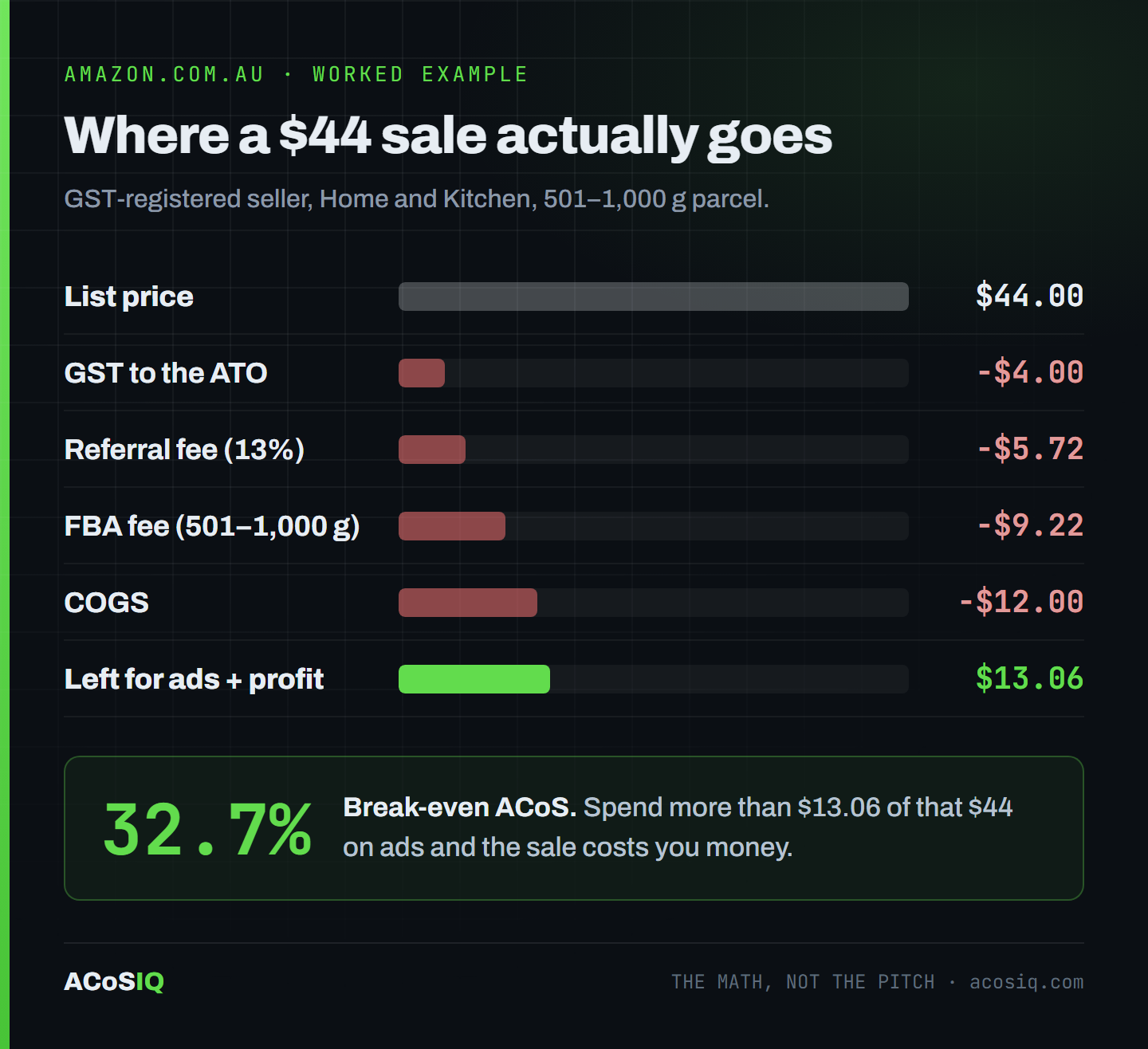
Work it through on a $44 Home and Kitchen product, GST-registered, 501–1,000 g parcel:
- List price $44.00 → net revenue $40.00 (the other $4 is GST going to the ATO)
- Referral fee at 13% of the $44 total sales price → $5.72
- FBA fulfilment fee → $9.22
- COGS → $12.00
- Margin left for ads and profit: 40.00 − 5.72 − 9.22 − 12.00 = $13.06
- Break-even ACoS = 13.06 ÷ 40.00 = 32.7%
Now run the same product as an unregistered seller. You keep the full $44 but pay GST on the fee, so it's 44.00 − 5.72 − 10.14 − 12.00 = $16.14 on $44, or 36.7%. Different number, different bidding decisions — and neither is the US answer.
Notice what drove it: the 13% Home and Kitchen rate, not the 8% a US-schedule assumption would have given you. That one substitution alone moves break-even by roughly five points. Applied to a 30% target ACoS you imported from a US playbook, it's the difference between a campaign clearing margin and one quietly eating it.
Use the Amazon Australia FBA Calculator to plug in your product's sale price, COGS, and category, and get your actual break-even ACoS in AUD. Once you have that number, your bidding decisions become mechanical rather than guesswork.
The Numbers to Run Before Any AU Campaign
Before setting a single bid on Amazon.com.au:
- Pull the current referral fee for your category from Seller Central
- Find your exact FBA size tier and fee from your Seller Central fee schedule
- Decide whether you're GST-registered — if not, use GST-inclusive FBA costs
- Calculate your break-even ACoS using AU figures, not US assumptions
- Set your target ACoS at 70–80% of that break-even to build in margin for growth
That number tells you what your ads can cost before they stop contributing to profit. Everything else — keyword selection, bid levels, campaign structure — is downstream of it.
If you want an independent read on whether your current ACoS targets actually make sense against your AU margins, that's literally what the free audit is — wasted spend, ACoS versus your real break-even, and bid structure, back to you as a short video with the three highest-leverage fixes.
FAQ
What are Amazon Australia's referral fees?
Amazon.com.au charges a referral fee on every sale, most commonly between 6% and 15% depending on category. Consumer Electronics is 8%, Home and Kitchen is 13%, Office Products is 13%, Toys & Games is 12%, and Media (Books, DVD, Music, Software, Video) is 15%. Several categories are tiered by price — Clothing & Accessories is 10% up to $20 and 13% above it. The fee applies to the total sales price including any delivery you charge, and unlike the US there is no minimum referral fee.
Do Australian sellers pay GST on Amazon FBA fees?
Yes. Amazon charges 10% GST on FBA fulfilment fees. If you hold an ABN and are GST-registered, you can claim that GST back on your BAS. If you're not registered, the 10% is a dead cost that eats directly into your margin.
How does Amazon Australia break-even ACoS differ from the US?
AU sellers face higher FBA fees in absolute AUD terms relative to typical sale prices, and GST on fees adds another layer if you're not registered. Run your break-even calculation with AU-specific fees before assuming your US targets transfer directly.
Want these fixes applied to your account?
Book the free audit